How People Get Hacked and Why Philippine Law Takes It Seriously
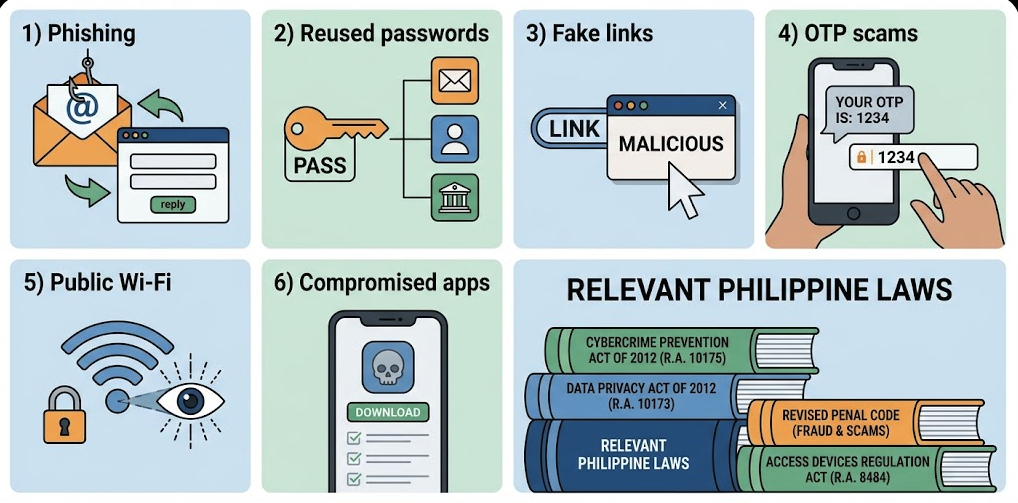
Most hacking incidents begin with ordinary moments: a fake bank message, a delivery link, a reused password, a public Wi-Fi login, or a one-time password shared with the wrong person. Philippine law treats these intrusions seriously because unauthorized access can quickly become identity misuse, data privacy harm, fraud, or financial loss.
Philippines
Most people imagine hacking as something complex. Dark rooms, lines of code, systems being broken into. The reality is much simpler, and that is what makes it dangerous.
It often starts with something ordinary. A message that looks like it came from a bank. A delivery notice. A link sent by a friend whose account has already been taken over. You click, type in your details, and move on with your day. Somewhere else, someone now has your password.
That is how many cases begin. Not with force, but with a small mistake that anyone could make.
This article is for general legal information in the Philippines and does not replace advice from counsel, law enforcement, your bank, your platform provider, or a cybersecurity professional for a specific incident.
There are other variations of the same story. You receive a one-time password, then someone calls, sounding official, asking you to confirm it. You give it, thinking you are securing your account. In truth, you are opening the door. In other cases, nothing dramatic happens at all. The password is just too simple, or reused across different accounts, and eventually it is guessed or exposed.
Some cases are even quieter. You connect to a public Wi-Fi network without thinking twice. You download an app from an unofficial source. You log in as usual. You never see the moment access is taken, only the aftermath when something feels off.
What ties all of these together is not sophistication. It is opportunity.
Why the law takes hacking seriously
Under the Cybercrime Prevention Act of 2012, unauthorized access to a computer system or account may constitute a cybercrime offense, depending on the facts. The law also addresses related conduct such as data interference, system interference, misuse of devices, and other computer-related acts. The point is that the law does not treat unauthorized access as harmless simply because it happens online.
In many situations, the problem does not stop at access. Once inside an account, a person may read private messages, copy personal information, or use the account to contact others. When that happens, another layer of law comes in. The Data Privacy Act of 2012 may be relevant when personal data is taken, misused, or disclosed without authority.
There are also cases where the damage becomes financial. Money is transferred. Purchases are made. Messages are sent to contacts asking for help or funds. At that point, the situation may cross into fraud. The Revised Penal Code of the Philippines, particularly provisions on estafa, may be relevant. If credit cards, digital wallets, account numbers, codes, or other access devices are involved, the Access Devices Regulation Act of 1998 may also come into play.
The pattern is clear. What begins as a simple intrusion can quickly expand into multiple violations, each carrying its own consequences.
The consequences can be serious. Depending on the offense proved, penalties may include imprisonment, fines, or both. Some online offenses may also carry heavier consequences because digital acts can spread quickly, affect more people, and cause harm beyond the initial account intrusion.
All of this matters because hacking is often dismissed as a minor or technical issue. Something that happens in the background. Something that can be fixed by resetting a password.
The law sees it differently. It recognizes that access to an account is not just about the account itself. It is access to identity, to information, to trust. Once that is taken, the effects can spread quickly and quietly.
Understanding how hacking actually happens strips away the illusion that it only affects a few. It also makes clear that there are consequences on the other side of it. Not just inconvenience, but liability.
That is the point worth remembering. Many cases begin in ordinary ways. The response, both practical and legal, is anything but ordinary.
Sources And Editorial Notes
Supreme Court E-Library: Cybercrime Prevention Act of 2012, Republic Act No. 10175 - https://elibrary.judiciary.gov.ph/thebookshelf/showdocs/2/50264 National Privacy Commission: Data Privacy Act of 2012, Republic Act No. 10173 - https://privacy.gov.ph/data-privacy-act/ Lawphil: Revised Penal Code of the Philippines, estafa provisions - https://lawphil.net/statutes/acts/act_3815_1930.html Supreme Court E-Library: Access Devices Regulation Act of 1998, Republic Act No. 8484 - https://elibrary.judiciary.gov.ph/thebookshelf/showdocs/2/4601