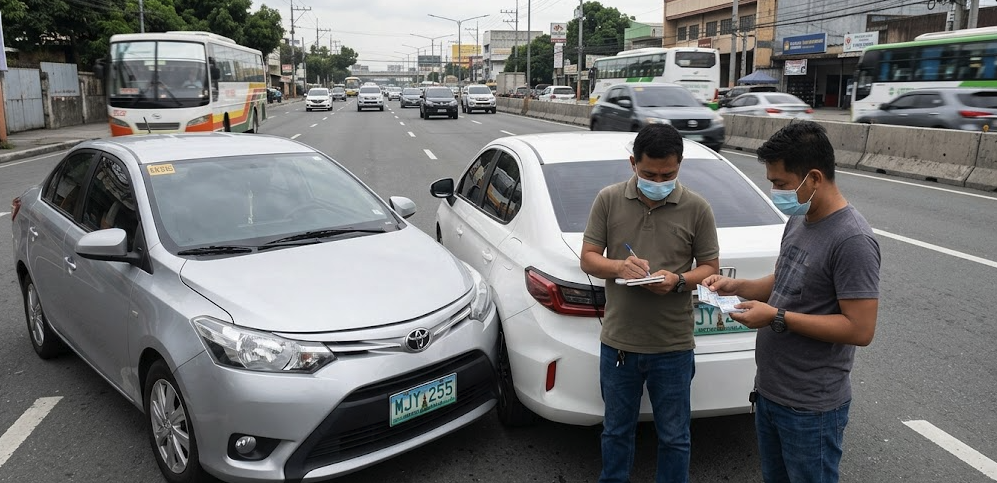
What to Do If You Get Into a Car Accident in the Philippines
After a car accident, the first few minutes matter. Stay calm, check for injuries, preserve the scene where safe, document the damage, get complete driver and insurance details, and secure an official record before making claims or agreements.
Philippines
It happens in a split second. A sudden stop. A bump you did not expect. Then silence, followed by confusion. Your instinct might be to react right away. That is exactly what you should avoid.
This guide is for general legal information in the Philippines and does not replace advice from counsel, your insurer, traffic authorities, or medical professionals for a specific accident.
- Do not escalate emotions
Tempers flare quickly after an accident. People argue, blame, raise their voices. That rarely helps. Keep things calm. Do not admit fault on the spot. Do not engage in a shouting match. Staying composed protects you more than any quick response.
- Make sure everyone is safe and call attention
Check if anyone is hurt. If there is any injury, call for help immediately. Even if it looks minor, it is best to get traffic enforcers or the police involved. Their presence keeps things under control and creates an official record.
- Do not move the vehicles just yet
If it is safe, leave the vehicles where they are. Their position tells part of the story. Moving too soon can make it harder to determine what really happened. If traffic forces you to clear the road, take photos first.
- Document everything while you can
Take clear photos and videos. Capture the damage, the position of the vehicles, the plate numbers, and the surroundings. Include road signs, lane markings, and anything that gives context. If you have a dashcam, secure the footage immediately. Make sure it is not overwritten. If there are nearby establishments, check if there is CCTV that may have recorded the incident.
- Get complete details from the other driver
Keep it straightforward. Take photos of the driver license, the vehicle registration, and the plate number. Ask for insurance details and take a photo of the policy or coverage document. It is easier to gather everything on the spot than chase it later.
- Understand the insurance involved
Registered motor vehicles are generally required to have compulsory motor vehicle liability insurance. This is usually aimed at third-party death or bodily injury claims, subject to the policy and applicable rules. It is different from comprehensive insurance, which may cover own damage or property damage depending on the terms of the policy. Knowing the difference early helps manage expectations because not every loss is automatically covered.
- Get a police blotter and check it carefully
Go to the nearest station and have the incident recorded. Do not treat this as a formality. Review the entry. If there is a sketch, make sure it matches what actually happened. Small errors at this stage can create bigger problems later.
- Know the basic rule on liability
Many accident disputes turn on negligence. Under Article 2176 of the Civil Code, a person who causes damage to another through fault or negligence may be liable for the damage done. In practical terms, liability depends on the evidence: vehicle positions, photos, videos, dashcam footage, witness accounts, traffic rules, and the official report.
- If the other driver clearly has no means
This happens more often than people expect. The other party may be at fault but has no real capacity to pay. Check if there is valid insurance and pursue that first. If you have your own comprehensive coverage, it may be more efficient to claim under your policy. Legal action is possible, but collecting on a judgment is another matter if the other party has no assets.
- Keep everything organized
Save your photos, videos, documents, and the police report. Keep copies in more than one place. These will support your claim and protect your position if there is a dispute.
A car accident can turn chaotic very quickly. The difference is often in how the first few minutes are handled.
Stay calm. Do not escalate. Document properly. Get the right details. Understand what you can realistically recover.
Handle it this way, and you avoid turning a bad situation into a worse one.
Sources And Editorial Notes
Insurance Commission: Insurance Code of the Philippines, Compulsory Motor Vehicle Liability Insurance - https://www.insurance.gov.ph/the-insurance-code-p-d-612/ Lawphil: Civil Code of the Philippines, Article 2176 - https://lawphil.net/statutes/repacts/ra1949/ra_386_1949.html LTO: Road and Traffic Rules / In Case of a Road Crash - https://www.lto.gov.ph/wp-content/uploads/2023/09/RO102_CDE_Road_and_Traffic_Rules_Rules-on-the-road.pdf Lawphil: Rules on Electronic Evidence, A.M. No. 01-7-01-SC - https://lawphil.net/courts/supreme/am/am_01-7-01_sc_2001.html