What to Do If You've Been Hacked in the Philippines
If an account, device, banking app, or social media profile has been compromised, the first priority is to secure access, preserve evidence, report suspicious activity, and understand when the incident may become a legal issue.
Philippines
You usually realize it a few seconds too late. A login alert you do not recognize. Messages you never sent. Money that moved without you touching anything. For a moment, nothing makes sense. Then it hits you.
Someone got in.
The instinct is panic. The better move is to slow down and take control, one step at a time.
This guide is for general legal information in the Philippines and does not replace advice from counsel, your bank, your platform provider, or a cybersecurity professional for a specific incident.
- Lock everything down
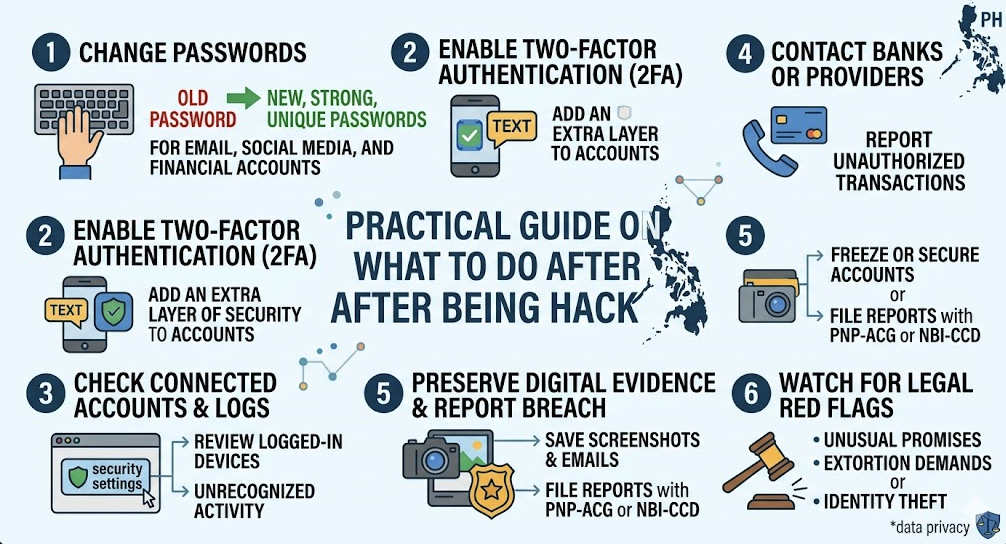
Start with access. Change your passwords immediately, especially for the affected account and anything connected to it. If you have been reusing passwords, assume those are exposed too. Turn on two-factor authentication. Log out of all active sessions. The priority is simple. Cut off whoever is inside.
- Check how far it went
Do not assume it is limited to one account. Look at your email, your banking apps, your social media. Scan for password reset notices, unfamiliar devices, or changes you did not make. Hacking tends to spread quietly. What you catch early, you can still contain.
- Call your bank or provider if money is involved
If there are suspicious transactions, act quickly. Banks and platforms can freeze accounts, reverse transactions, or flag activity. Time matters here. The earlier you report it, the more options you have.
- Save your evidence before you clean up
This is the part people skip. They rush to delete messages or fix the account, and in the process, lose the record of what happened. Take screenshots of everything unusual. Logins, messages, transaction records, changes in account settings. Make sure usernames, dates, and timestamps are visible. Save emails and alerts. Keep copies in more than one place. Under the Rules on Electronic Evidence, digital records can be used later, but only if they are complete and can be authenticated.
- Report the breach to the platform
Most services have a process for compromised accounts. Use it. It creates a record that the access was unauthorized and can help you recover control. It also matters if the situation escalates.
- Know when it becomes a legal issue
Not every hacked account becomes a legal case, but some incidents do. Unauthorized access may be relevant under the Cybercrime Prevention Act of 2012. If personal data was taken, exposed, or misused, the Data Privacy Act of 2012 may apply. If money, account numbers, cards, codes, or other access devices were used, the Access Devices Regulation Act of 1998 may also be relevant. The right remedy depends on what was accessed, what was taken, and what damage followed.
- Write down what happened while it is fresh
Keep a simple timeline. When you noticed the issue. What you saw. What you did. It does not need to be formal. It just needs to be clear. Memory fades quickly in stressful situations. A written record keeps things grounded.
- Avoid making things harder for yourself
Do not edit your screenshots. Do not rely on memory alone. Do not assume the problem will fix itself. Small decisions at this stage can affect what you can prove later.
- Manage the aftermath
If your account was used to message others, let them know. Watch for follow-up attempts. Once information is exposed, there is always a risk of a second round. Stay alert for a while.
Being hacked feels personal because it is. Someone steps into your space, uses your name, and moves through your accounts as if they belong there.
The response does not have to be chaotic. Secure access. Keep your records. Report what needs to be reported. The law already recognizes that unauthorized access and misuse of data are real harms, not minor inconveniences.
Act early, and you keep things contained. Wait too long, and the problem tends to grow beyond where it started.
Sources And Editorial Notes
Supreme Court E-Library: Cybercrime Prevention Act of 2012, Republic Act No. 10175 - https://elibrary.judiciary.gov.ph/thebookshelf/showdocs/2/50264 Lawphil: Rules on Electronic Evidence, A.M. No. 01-7-01-SC - https://lawphil.net/courts/supreme/am/am_01-7-01_sc_2001.html National Privacy Commission: Breach Notification - https://privacy.gov.ph/breach-notification/ National Privacy Commission: Data Privacy Act of 2012, Republic Act No. 10173 - https://privacy.gov.ph/data-privacy-act/ Supreme Court E-Library: Access Devices Regulation Act of 1998, Republic Act No. 8484 - https://elibrary.judiciary.gov.ph/thebookshelf/showdocs/2/4601